
Le Pouce or Pieter Both?
Le Pouce and Pieter Both stand less than three kilometres apart on the same ridge and differ in height by eight metres. In every other way they are different mountains. Le Pouce is a walk that ends in a few metres of hands-on rock. Pieter Both ends on a boulder nine metres across that nobody reaches without a rope.
Read the guide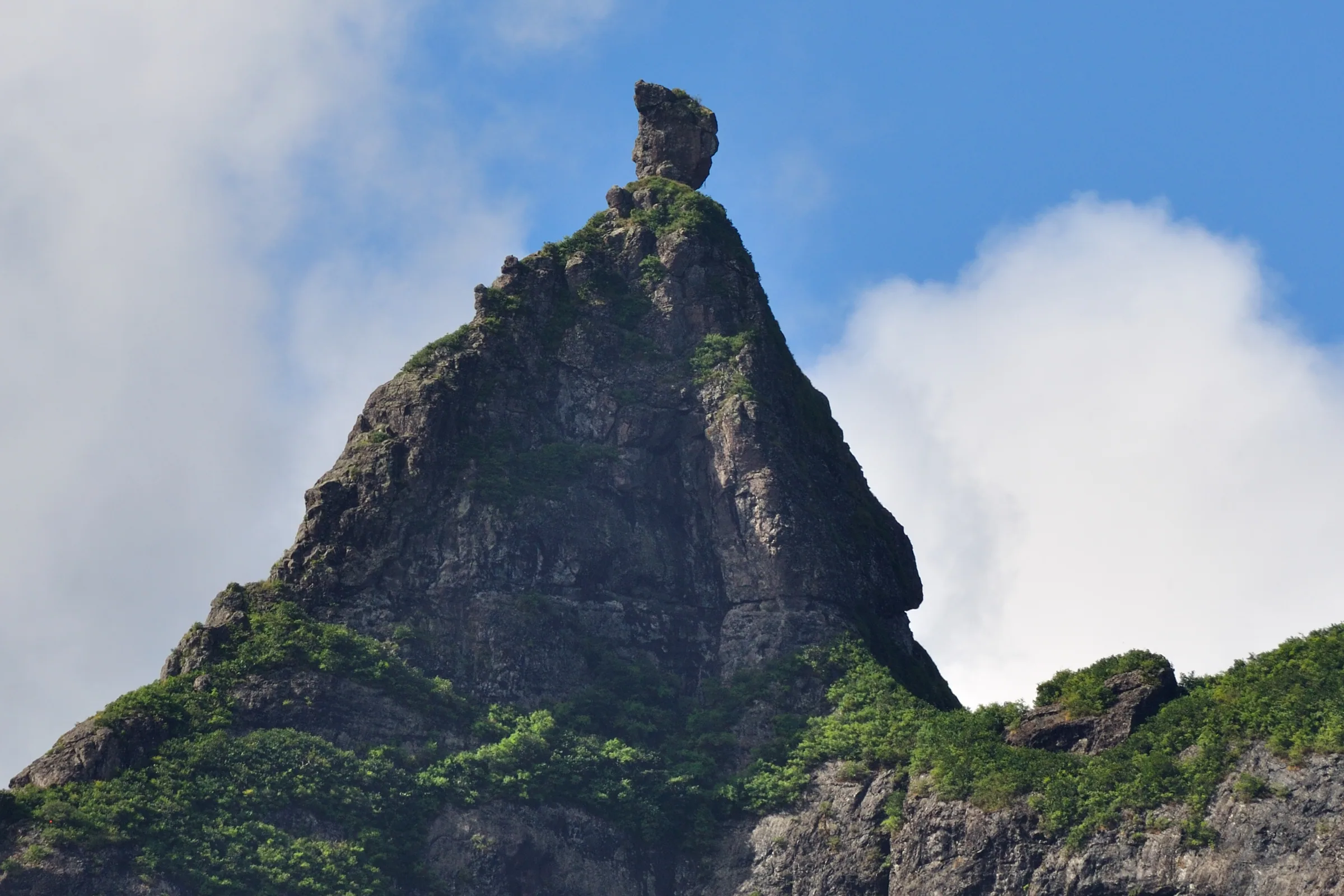
Two neighbours eight metres apart
Pieter Both is the second-highest mountain in Mauritius at 820 m, eight metres below Piton de la Petite Rivière Noire. Le Pouce is third at 812 m. Both belong to the Moka Range that curves around Port Louis, and PeakVisor measures the gap between them at 1.7 miles, about 2.7 km, with Pieter Both to the east-north-east of the thumb. The heights are not quite settled. The Key Biodiversity Area factsheet gives Pieter Both 823 m, and Wikipedia’s geography page lists Le Pouce at 820 m while its Le Pouce article says 812 m. This site uses 820 m and 812 m.
The names tell you how each was seen. Pieter Both is named after the first Governor-General of the Dutch East Indies, and older English texts call it Peter Botte Mountain. Its summit rock has the shape of a human head balanced on shoulders, and that head is what every legend and every climber is about. Le Pouce is simply the thumb. Darwin, writing in 1836, explained that the mountain was so called from a thumb-like projection, and no earlier written explanation has been found.
The walk and the climb
From the Petit Verger car park above Saint-Pierre, the mapped route to the summit of Le Pouce is 2.05 km one way with about 390 m of ascent. Most people are up and down in two to three hours. Sources range from 1 h 45 for a fast loop to four hours for a slow party with a long stop on top. The path is waymarked in blue and white, the col arrives in under an hour, and the only technical ground is the final spur, where the path narrows into a trench along the ridge for the last 30 m or so and you use a hand or two over a few metres of rock. No gear is needed. The exposure is real but brief, and anyone who dislikes it can stop on the meadow below and still have the view.
Pieter Both is another matter. Wikipedia describes the main ridge as about an hour of mildly difficult scrambling, exposed, with a rope advised. The site dedicated to that mountain gives the route from the football pitch at La Laura as 3.3 km return with 450 m of ascent and about four hours in all, including equipment checks and the roped section. The summit boulder is about nine metres across with iron spikes fixed into it to help climbers, and its flat top is about two metres wide. A professional guide and climbing equipment, meaning helmet and harness as well as rope, are required for the summit. The same site warns that some outings sold as summit experiences end beside the boulder rather than on it, which is worth asking about before you book.
| Le Pouce | Pieter Both | |
|---|---|---|
| Height | 812 m | 820 m (823 m in the KBA factsheet) |
| Rank in Mauritius | Third | Second |
| Usual start | Petit Verger car park at 381 m, above Saint-Pierre | La Laura football pitch |
| Distance | About 4 km return | About 3.3 km return |
| Ascent | About 390 m | About 450 m |
| Time | 2 to 3 hours for most | About 4 hours including rope work |
| Summit | Narrow rock finish, hands for a few metres | Boulder about 9 m across, iron spikes, 2 m flat top |
| Gear | Good shoes, water, a hat | Rope, harness, helmet |
| Guide | Optional | Required for the summit |
| Fee | None | Guide fees apply |
| First recorded climb | Not recorded. Darwin climbed it in May 1836 | 7 September 1832 |
The first ascent and the stone head
Pieter Both was first climbed on 7 September 1832 by Captain Lloyd, Lieutenant Phillpotts of the 29th Regiment, Lieutenant Keppel of the Royal Navy and Lieutenant Taylor. The Captain Lloyd who lent Darwin an elephant four years later was John Augustus Lloyd, Surveyor-General of Mauritius, and he is very probably the same man, although the sources used here do not say so in as many words. Le Pouce has no recorded first ascent at all. It is a walk, and people had presumably been walking up it long before anyone thought the fact worth writing down. Matthew Flinders drew the view to the sea from its shoulder during his detention on the island between 1803 and 1810, and Darwin climbed it in early May 1836, on 2 May according to most sources.
The legend belongs to Pieter Both. A milk seller named Shyantak, resting on the mountain, saw fairies dancing and was sworn to secrecy. He broke the vow and was turned to stone where he stood, which is why the head sits on the summit. A later belief held that the British would leave Mauritius when the head finally rolled off. It has not, and they did. Le Pouce has no legend of its own that the research for this site could find. Its story is the view, Darwin, and the daily traffic of Port Louis walkers who treat it as their hill.
Where each climb starts
Le Pouce has two established starts. The standard one is the small car park at Petit Verger, reached by a farm road off the B47 between Moka and Saint-Pierre, at 381 m. The longer one is from Tranquebar in Port Louis, where Chateau d’Eau Street ends below the Le Dauguet trail, at about 88 m. That northern route is 3.6 km one way with about 690 m of ascent, more gradual, shadier and much longer. Buses serve Saint-Pierre, Moka and Tranquebar, so a through-hike from one side to the other is realistic.
Pieter Both is climbed from La Laura, in Moka District, the village that Wikipedia also names as the nearest to Le Pouce. The route described on the Pieter Both site begins at the village football pitch, where guided parties meet with their equipment. There is no dedicated visitor facility on either mountain, and no entrance fee on Le Pouce.
Who should choose which
Put simply, Le Pouce is the mountain for almost everyone and Pieter Both is the mountain for people who already know they want a roped climb.
- Choose Le Pouce if this is your first mountain in Mauritius, if you have a single free morning, or if you want the view over Port Louis without committing to technical ground.
- Choose Le Pouce with children. Walking children of eight to ten manage the standard route, guided outings set a minimum age of ten, and the meadow below the summit is a complete objective in itself.
- Choose Pieter Both if you are comfortable on exposed rock, happy to be roped to a guide, and have about four hours and the budget for a professional. The boulder is the whole point, so make sure the outing actually goes to the top of it.
- Choose neither in strong wind, low cloud or after heavy rain. Both summits are exposed, and the rock on Le Pouce is slippery when wet.
- If you have two days, do Le Pouce first. It shows you Pieter Both’s head from across the col and tells you whether you want to be standing on it.
Seeing one from the other
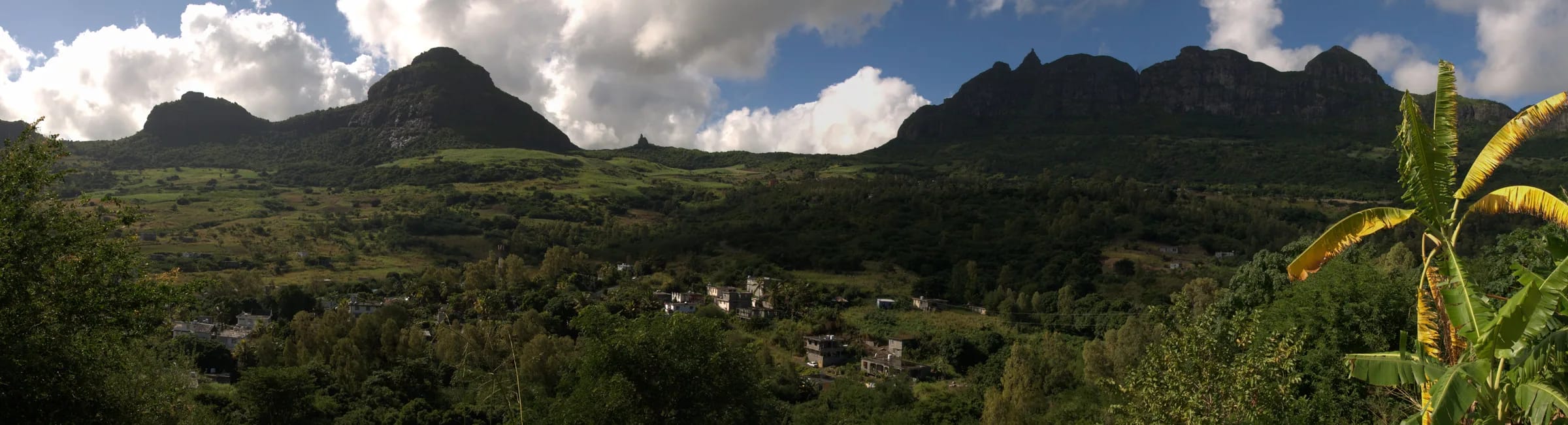
Few pairs of mountains are so good at showing each other off. From the grassy meadow below the Le Pouce summit, and again from the top, Pieter Both’s head is in full view across the col, close enough to read the shoulders beneath it. Wikipedia’s own gallery includes the view from Le Pouce facing Pieter Both, and it is the photograph most people take there after the one of Port Louis. From the Pieter Both ridge the thumb stands at the same distance in the other direction, with the capital spread beneath it.
This is also the practical argument for climbing Le Pouce first. You will see exactly what the Pieter Both ridge looks like, how far the boulder stands above the shoulders, and how the cloud behaves on the two summits. If the head is wrapped in cloud at nine in the morning while the thumb is clear, you have learnt something about which of the two to book.
Questions people ask
Is Pieter Both harder than Le Pouce?
Yes, by a clear margin. Le Pouce is a waymarked walk whose only hands-on ground is a few metres of rock at the top. Pieter Both’s main ridge is an exposed scramble of about an hour, and the summit boulder, nine metres across with iron spikes, is climbed on a rope with a guide. Expect about four hours for Pieter Both against two to three for Le Pouce.
Which is higher, Le Pouce or Pieter Both?
Pieter Both, at 820 m against Le Pouce’s 812 m. The biodiversity factsheet gives Pieter Both 823 m, and one Wikipedia page lists Le Pouce at 820 m, but the Le Pouce article and OpenStreetMap agree on 812 m. Only Piton de la Petite Rivière Noire at 828 m is higher than either.
Can you climb Pieter Both without a rope?
The ridge below the boulder is scrambled by experienced people, and Wikipedia advises a rope even there because it is exposed. The boulder itself is a climb. The guide site for the mountain states that a professional guide and climbing equipment are required for the summit. Treat that as the rule rather than a suggestion.
Can you do Le Pouce and Pieter Both in one day?
Not as a single traverse, because there is no published ridge route between them. By road it is possible for a fit party, since Petit Verger and La Laura are close, but Pieter Both alone takes about four hours with ropes and both summits are best in morning weather. Most people give each mountain its own morning.
Why is Pieter Both called that?
After Pieter Both, the first Governor-General of the Dutch East Indies, from the period when the Dutch held Mauritius. English writers of the colonial era spelt it Peter Botte. The head-shaped boulder gave rise to the Shyantak legend, in which a milk seller who broke a vow of secrecy to the fairies was turned to stone.
Does Le Pouce have a legend like Pieter Both?
None that the research for this guide could find. The legend of the milk seller turned to stone belongs to Pieter Both. Le Pouce’s stories are historical rather than mythical, from Flinders drawing on its shoulder before 1810 to Darwin climbing it in 1836 and describing the view over the cane fields.
Walk the one you can walk
The Le Pouce hiking guide takes the standard route from Petit Verger stage by stage, including the steep finish.