
A full day around Le Pouce
The best day on Le Pouce starts in the half-dark and ends on the Citadel in Port Louis, looking back at the thumb you stood on that morning. In between are a late breakfast in Moka, a Creole house with 109 doors and windows and the capital’s market. This page lays the day out hour by hour, then gives a half-day version and what to do when the summit is in cloud.
Read the guide
Why the hike comes first
Everything else in the day is flexible. The hike is not. Le Pouce is best climbed early, when the air is cool, the lower track through the cane is still in shadow and the summit has not yet gathered its cloud. Hikers who start late report heat on the open sections, wind and sudden rain near the top and, on bad days, no view at all.
First light is not the same as a sunrise summit. To watch the sun rise from the top you must walk the lower track by torch, which the sunrise page covers. The plan here starts walking as the sky brightens, between about 05:30 and 06:30 depending on the month, and reaches the summit by mid-morning.
The published figures agree closely enough. Most people reach the shoulder, a grassy plateau at about 620 to 625 m, in under an hour. The final climb to 812 m is short but steep, with hands on rock for the last stretch. Two to three hours for the round trip is typical, with fast walkers under two and families nearer four.
The full day, stage by stage
The timings assume a first-light start in the drier months. Shift everything by half an hour either way for the season, and add time if it has rained.
Before dawn, leave your base
From Moka this is a ten-minute drive. From Port Louis allow roughly 20 to 25 minutes, from Flic en Flac about 40 and from Grand Baie about 45. The lane to the car park leaves the Bois Chéri Road at a sharp bend between Moka and Saint-Pierre, marked by a small brown Le Pouce sign, and is easy to miss in the half-dark.
First light, start walking
The track leaves the car park at 381 m, passes a large kiosk that serves as a shelter and climbs through cane and then forest on switchbacks. Blue and white waymarks on posts and trees show the way, and you keep the summit on your left at junctions. The view opens as you gain the ridge.
Within the hour, the shoulder
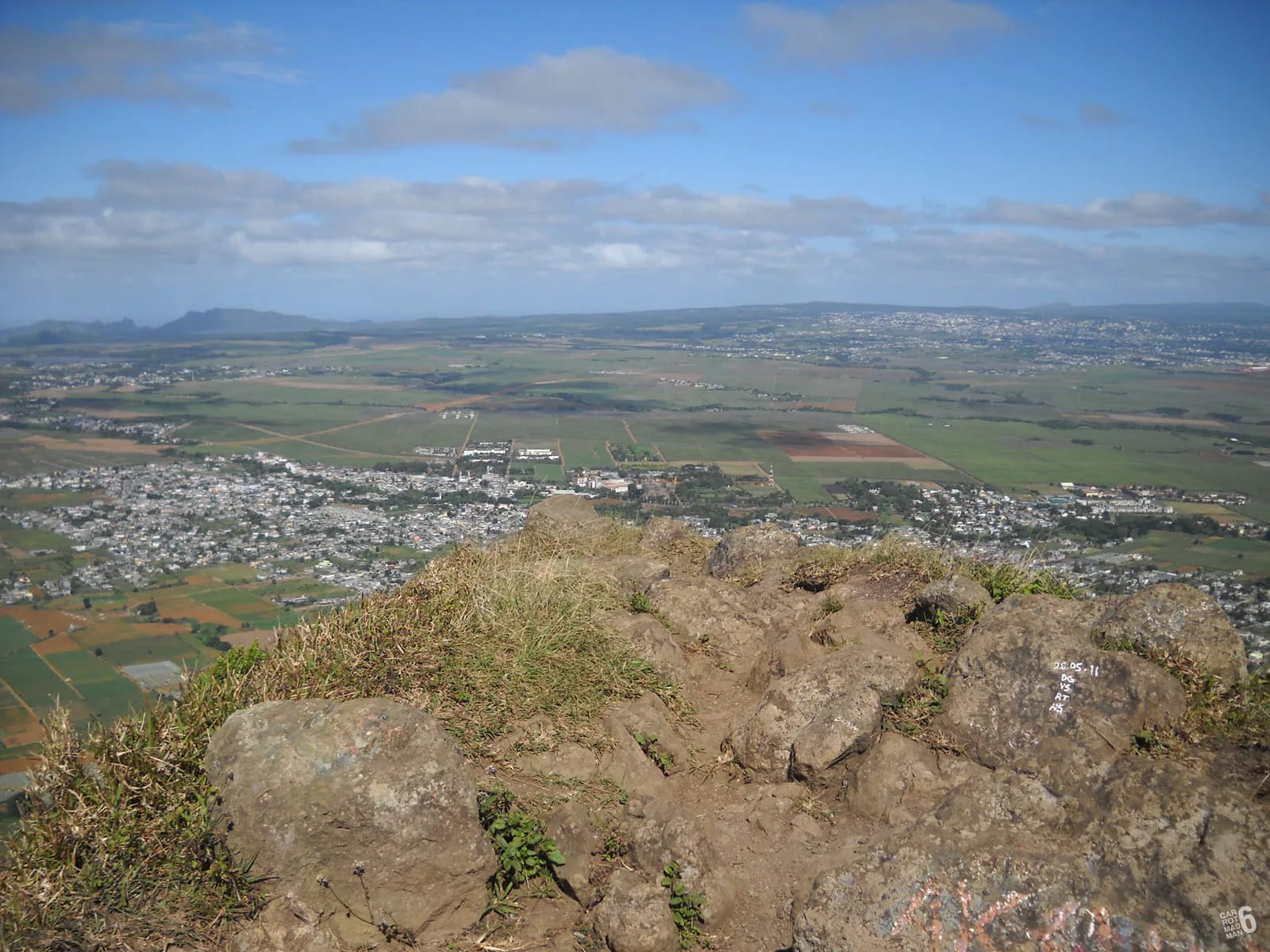
The path arrives on a grassy plateau at about 620 to 625 m with Port Louis, the harbour and the northern plain laid out below, and Pieter Both’s balanced boulder to the east. This is the natural place to eat the breakfast you carried, and to turn round if anyone in the group is unhappy about the last section.
Mid-morning, the summit
The final climb is narrow and steep, with rock steps, ledges and a trench along the ridge where a hand or two on the rock is needed for a few metres. It is exposed, and wet rock is slippery. The top is small, so take your photographs and leave room for the next group.
Late morning, back at the car
The descent takes most people about an hour and is where ankles turn, especially on the steep upper section after rain. By half past nine or ten you are back at the car, ready for the first real meal of the day.
Late breakfast in Moka or Saint-Pierre
Saint-Pierre has small snack bars and shops along the main road, with no guarantee of what is open. Moka has cafés shaped by its university and offices, and Bagatelle has a food court when you want certainty. Dholl puri, roti, fried noodles and a cold drink are the local answer to a morning on the mountain.
Midday, Eureka
Eureka is the wooden Creole mansion of 1830 in Moka, ten minutes from the trail, with its 109 doors and windows and tambalacoque beams. It has been open as a museum since 1986. Check opening days and times before you go, as they are not published here, and allow an hour to an hour and a half.
Afternoon, Port Louis
Drive or take the bus into the capital, roughly 20 to 25 minutes. Begin at Aapravasi Ghat on the waterfront, the immigration depot of 1849 through which almost half a million indentured labourers passed between 1834 and 1920, a World Heritage Site since 2006. Then the Central Market before it winds down, and Chinatown a couple of blocks north.
Late afternoon, the Citadel
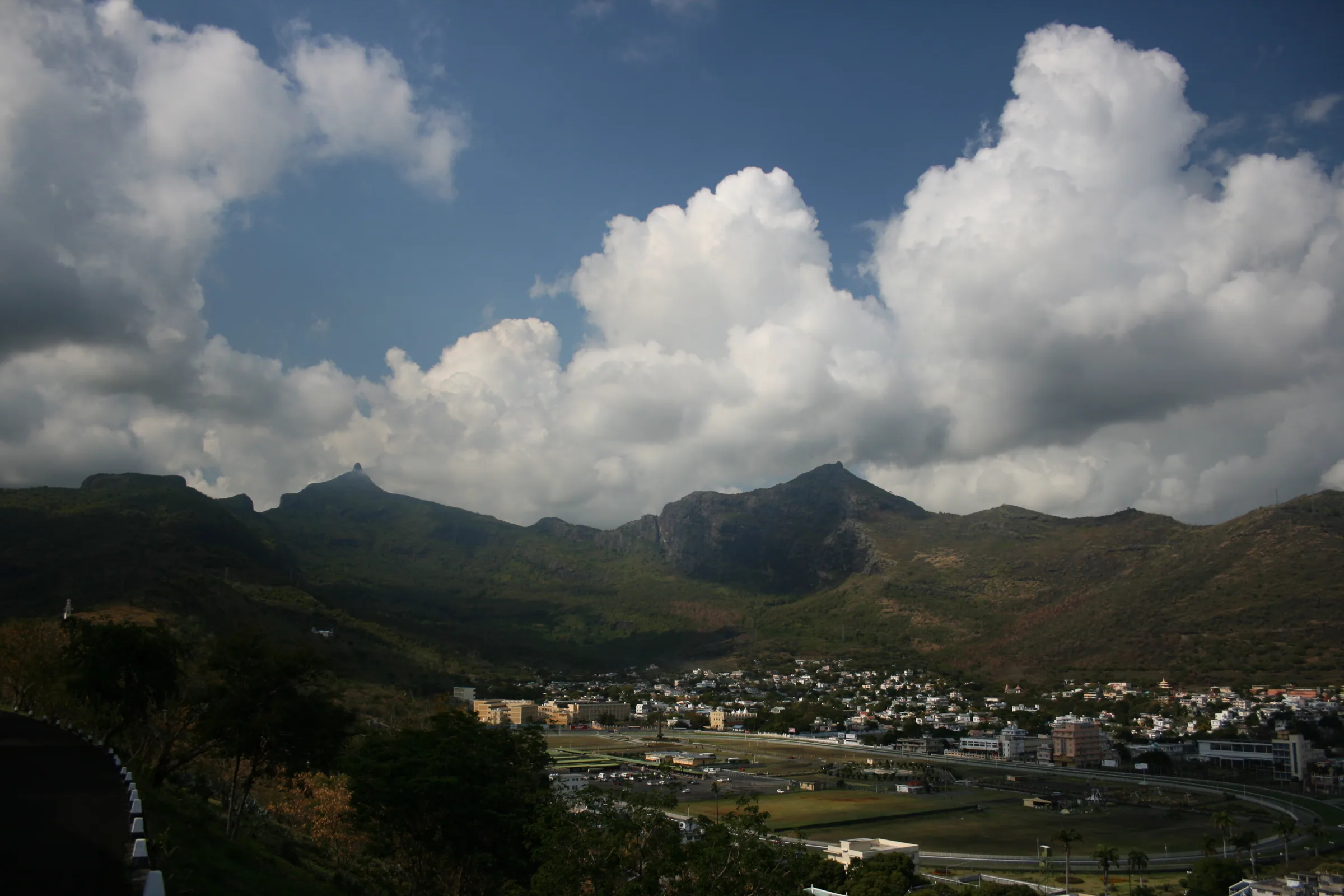
Finish on Fort Adelaide, the basalt fort the British completed in the second half of the 1830s on the hill above the Champ de Mars. From its walls the city, the harbour and the Moka Range are in view, with Le Pouce standing clear behind the racecourse. Sunset is between about 17:38 in June and 18:55 in January and dusk lasts about twenty minutes, so be heading home before dark.
Timings for the full day
A representative schedule for a morning when sunrise is around six. In November and December everything can start forty minutes earlier; in June and July it starts later and the afternoon is shorter.
| Time | Where | Notes |
|---|---|---|
| 05:30 to 06:00 | Leave your base | Moka 10 minutes, Port Louis roughly 20 to 25, the coasts 40 to 45 |
| 06:00 to 06:15 | Petit Verger car park, 381 m | Four or five spaces, fills at weekends |
| By 07:00 | The shoulder, about 620 m | Breakfast, the main view, the turnaround point |
| 07:15 to 08:00 | Summit, 812 m | Short stay, small top, hands on rock on the way up and down |
| 09:00 to 09:30 | Back at the car | Two to three hours in total for most |
| 10:00 to 12:30 | Saint-Pierre or Moka, then Eureka | Late breakfast, then the house; check current opening |
| 13:30 to 15:00 | Aapravasi Ghat | After a drive of roughly 20 to 25 minutes |
| 15:00 to 16:30 | Central Market and Chinatown | The market is quieter by late afternoon |
| 16:30 to 17:30 | The Citadel | The view back to Le Pouce, then leave before dusk |
The half-day version
If the morning is all you have, keep the hike and the breakfast and drop the rest. First light at Petit Verger, the summit by mid-morning, Saint-Pierre or Moka by ten, and you are free by eleven with the best of the day done. Eureka fits if you have until early afternoon. Port Louis does not, because the capital deserves its own afternoon and the market is at its best in the morning.
For hikers staying in Port Louis without a car, the half day is the northern route from Tranquebar as far as legs and heat allow. The signposted junction where the Le Pouce trail turns left and steepens is a fair objective for a short morning. The full climb from this side, with about 690 to 820 m of ascent depending on the line, is a long half day in itself.
- Do the hike in the morning, never as the afternoon half. Heat, cloud and a short dusk all argue against it.
- If the summit is your priority, go on a weekday when the car park and the top are quieter.
- If the view is your priority and the top is clouded, the shoulder at about 620 m is a complete outing in itself.
The rainy-day version
Rain changes the mountain more than the city. The upper path turns to mud, the final hundred metres of rock become steep and slippery, hikers report strong wind and sudden showers near the top, and a clouded summit gives no view at all. On a wet morning the honest choice is to swap the day round and keep the hike for the next clear window.
Port Louis sits in the rain shadow of the south-east trade winds, so a grey morning in Moka can be a dry one in the capital. Spend the morning under cover at Aapravasi Ghat, in the market hall and in Chinatown, then drive up to Moka for Eureka after lunch. If the ridge clears by mid-afternoon, resist the temptation to climb. The rock stays wet for hours and the light goes at dusk. Go the following morning instead.
In the cyclone season, November to April with an official warning window to mid-May, a warning in force means staying off the mountain and expecting the city to shut down too.
The day without a car
The full day can be done by bus with one adjustment, which is to hike across the mountain instead of returning to the car park. Take a bus to the Saint-Pierre traffic centre, where routes 153 from Curepipe and 167 from Henrietta terminate, walk uphill to the trailhead, climb to the summit, and come down the northern path to Tranquebar in Port Louis. From there the centre is a walk or a short bus ride, and the afternoon follows as above. Eureka is the casualty, since it sits on the Moka side.
The through-hike is about 6 km from Saint-Pierre to Tranquebar with roughly 390 m up and 690 m down, on a northern path that is longer, shadier and stonier than the Moka side. Allow most of a morning. The bus page has the connections.
What breaks the plan, and what to do
None of these spoils the day if you have decided in advance what you will do.
- The car park is full. Park on the verge without blocking the lane, as others do, or come back on a weekday. Leave nothing of value in the car.
- Cloud is sitting on the summit when you reach the shoulder. Wait twenty minutes with your breakfast, since cloud on Le Pouce often moves. If it does not, the shoulder is the day’s view.
- It has rained overnight. Go, but slow down on the upper section, expect mud, and decide at the shoulder whether the final rock is for you.
- Someone turns an ankle. In August 2026 a hiker was carried down the Saint-Pierre side by stretcher after a sprain on the descent. Police are on 999 or 112, the ambulance service on 114. Coverage on the ridges is generally decent, but do not rely on it.
- You run out of afternoon. Drop Eureka before you drop the Citadel. The view back to the mountain closes the day better than anything else.
Questions people ask
How long does the full Le Pouce day take?
From leaving your base before dawn to coming down from the Citadel at dusk, about twelve hours, of which the hike is two to three. Sunrise is between 05:22 and 06:45 depending on the month and sunset between 17:38 and 18:55, so the day is longer in the southern summer and shorter in June and July. The half-day version is done by eleven.
Can I do the hike and Port Louis in one day without a car?
Yes, by hiking across the mountain. Take a bus to the Saint-Pierre traffic centre, walk up to the trailhead, climb to the summit and descend the northern path to Tranquebar, then walk or take a bus into the centre. Eureka is on the wrong side of the mountain for this version, so leave it for another day. The bus page has the connections.
Is Eureka open every day?
This guide does not publish Eureka’s hours because they change and no official source was reviewed for them. The house has been open as a museum since 1986 and sits ten minutes from the trail. Check its current opening days and times before you go, and have the Central Market as the fallback if it turns out to be closed.
Can I see Le Pouce from Port Louis?
Yes. The thumb stands directly behind the city to the south-east, and the clearest view is from Fort Adelaide, the Citadel on the hill above the Champ de Mars, where the Moka Range is in sight across the rooftops. It is the natural place to end the day, looking back at where you stood that morning.
What if the summit is in cloud?
Wait on the shoulder for a while, since cloud on Le Pouce often moves, and treat the shoulder at about 620 m as the day’s viewpoint if it does not. Do not climb the final rock in cloud or strong wind. It is exposed and slippery when wet, and there is no view at the top to reward the risk. Swap the day round and try again the next clear morning.
Should I do Port Louis first and hike in the afternoon?
No. Afternoons bring heat on the open track, cloud on the ridge and a dusk that lasts about twenty minutes, and the lane to the car park is hard to find after dark. Hike first, always. If you want the city in the morning, make it a separate day, or do the rainy-day version and save the climb for the next clear dawn.
Start with the climb
The hiking guide describes the Petit Verger route stage by stage, with the steep finish explained.