
Le Pouce with children
Le Pouce works well as a family mountain if you choose the right summit. For most children that is the open shoulder at roughly 620 m, about an hour above the Petit Verger car park, with the whole of Port Louis laid out below. The final spur to the true summit is steep, narrow and exposed, and it is not a place for a child who might freeze. This page explains what ages manage the approach, where to stop, how long it takes and what to do instead if the mountain is too much for the day.
Read the guide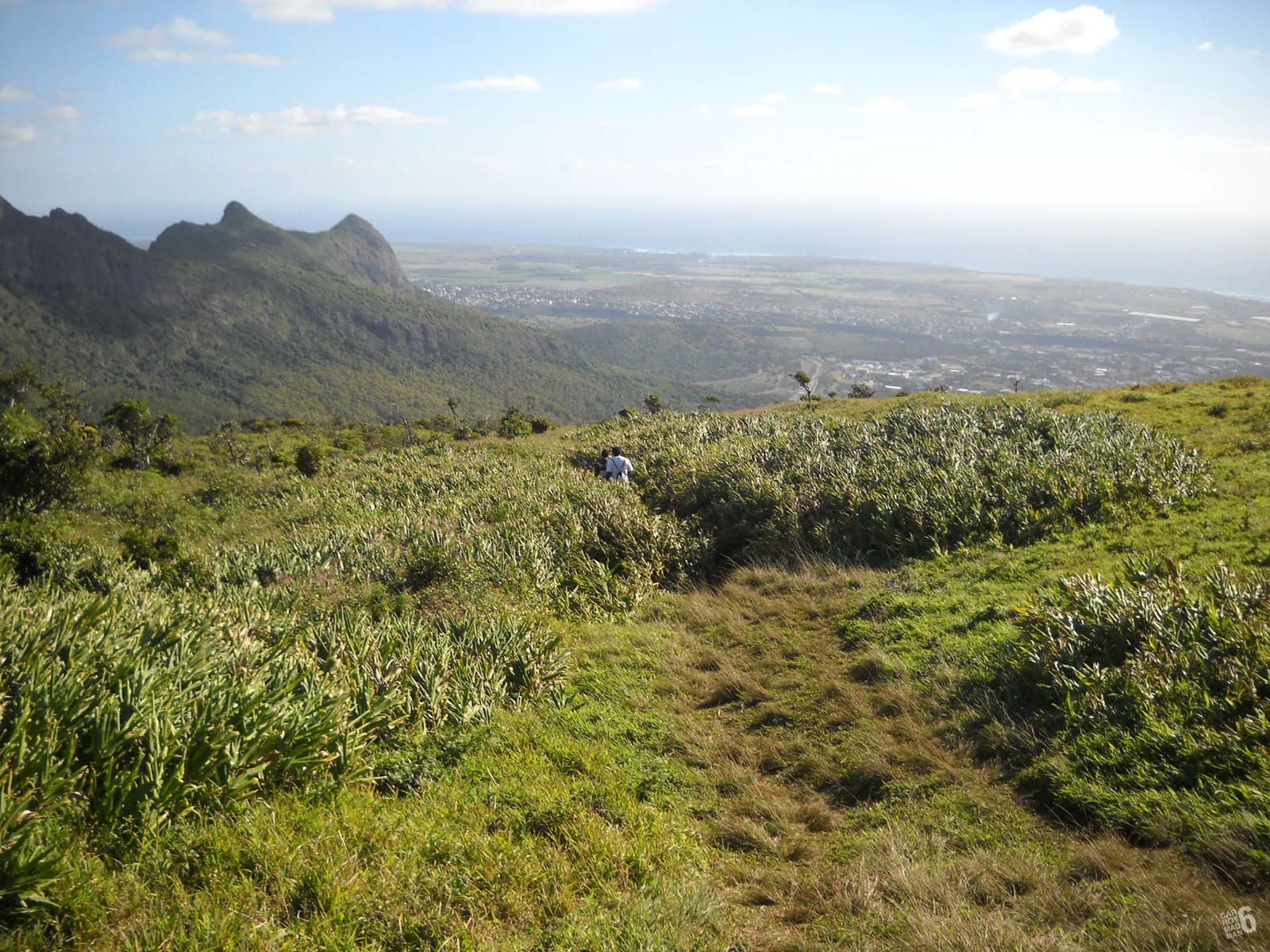
The shoulder is the family summit
The standard route from Petit Verger has two halves that could belong to different mountains. The first is a farm track through cane, a kiosk at about 437 m, a small rock shrine and a set of forest switchbacks that bring you out onto an open grassy shoulder at roughly 620 m. It is steady, it is shaded for a good part of the way and it has somewhere to stop every few minutes. The second half is the thumb itself, a narrow spur that climbs about 190 m in well under a kilometre, with ledges, short catwalks over real drops and a trench in the ridge before a rock step at the top.
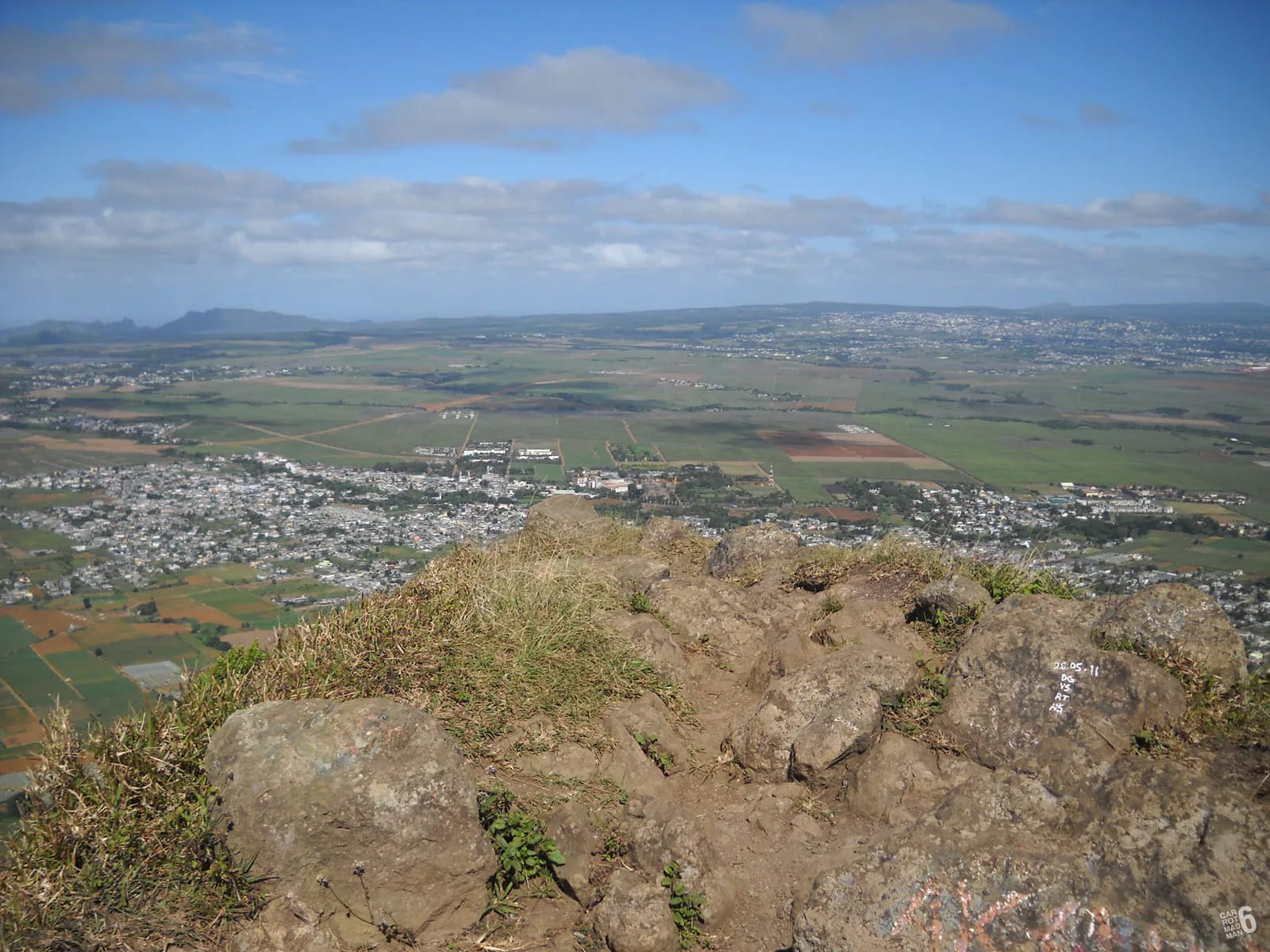
For a family, the shoulder is the destination. It has the view that people come for, Port Louis and its harbour, the northern plain and Pieter Both with its balanced boulder across the ridge. It has room to sit, eat and run about safely away from the edge. The true summit, by contrast, is a rocky point that becomes uncomfortable above about ten people, where the sensible instruction is to stay seated. Tell children before you start that the top of the walk is the big grassy ledge, and that the pointy bit is for another year.
What ages manage it
Sources disagree a little, which is itself useful. A detailed local hiking guide says walking children of 8 to 10 manage the route without trouble, meaning the approach to the shoulder and, for confident ones, the summit. Operators running guided hikes set a minimum age of 10 for mixed groups and ask for moderate fitness. Both are honest. A child of eight who walks regularly will enjoy the shoulder. A child of ten with a parent close behind can manage the spur in dry, calm weather, but many will prefer not to, and that is fine.
Below about eight it depends entirely on the child and on the parent’s willingness to carry. The farm track and the first switchbacks are manageable for small children at their own pace, and turning around at the kiosk or in the forest is still a good morning out. Nobody should take a child onto the final spur who cannot be trusted to move calmly on narrow ground with drops beside it, whatever their age.
In August 2026 a woman hiking with her husband and three children sprained an ankle on the descent of the Saint-Pierre side and had to be carried down by stretcher. The children were fine. The incident is a reminder that the adult is often the one who gets hurt, on the way down, and that a family group should keep a pace that leaves everyone fresh for the descent.
Where to stop, and how to say it before you start
The natural stopping point is the base of the final spur, where the open shoulder narrows and the path begins to climb steeply onto the rock. It is obvious when you reach it. The grass gives way to rock, the path becomes a single line and the ground falls away on either side. Stop a little short of it, on the wide part of the shoulder, where there is space to sit without anyone standing near an edge.
Say the plan at the car park. Children deal well with a clear goal and badly with a goal that moves. If the shoulder is the summit, call it that from the start, celebrate it when you arrive, and do not stand at the base of the spur debating. If one adult wants the true summit, the group can wait on the shoulder with the view while they go, which takes a fit adult 30 to 45 minutes there and back.
Timings at a family pace
Adults reach the shoulder in under an hour from Petit Verger. With children, allow about an hour and a half, and the same again for the descent, which is slower on the forest section when it is muddy. The whole outing, with a long stop on the shoulder, is a comfortable three hours and fits before lunch.
Start early. A 07:30 start in summer has you on the shoulder before the heat and back at the car before the sun is overhead. In winter, from June to September, a start between 08:00 and 09:00 is comfortable.
Car park to the kiosk, about 20 to 30 minutes
A farm track through cane climbing gently to a large kiosk at about 437 m. Easy walking, good for settling small legs into a rhythm. Take the path that climbs from the kiosk, not the level one.
Kiosk to the top of the forest, about 30 to 40 minutes
Switchbacks through forest with a small rock shrine on the way. The shade is welcome in summer. This is where you decide whether the group is enjoying itself enough to continue.
Out onto the shoulder, about 10 to 20 minutes more
The forest opens onto grass and the view arrives all at once. Walk to the wide part of the shoulder and stop well short of the spur.
The stop
Half an hour is about right. Eat, drink, point out Port Louis, the harbour and Pieter Both. Keep children away from the northern edge of the shoulder, where trodden lines lead to viewpoints with drops.
Descent, about an hour
The same way down. Take the forest switchbacks slowly if they are wet, and keep the pace that gets everyone to the car without a twisted ankle.
The hazards that matter with children
Le Pouce has none of the dangers visitors sometimes imagine. There are no venomous snakes and no large animals in Mauritius. The real hazards are ordinary ones made sharper by height and heat.
- Sun. Above the forest there is no shade. Hats, sunscreen at the car and a litre of water per child are the minimum.
- Mud and wet rock. After rain the forest path is slippery and the descent is where sprains happen. Shoes with grip, not sandals, for everyone.
- The edges. The spur has drops on both sides, and the northern edge of the shoulder has trodden lines to viewpoints that end in air. Keep children on the inside of the path and within reach.
- Monkeys. They are seen near the path on the Petit Verger route and are not pushy, but keep food inside the bag and do not let children feed them.
- Mosquitoes. A feature of the Port Louis side in particular. Repellent if you go that way.
- Dusk. Night falls in about twenty minutes here, with sunset between roughly 17:40 in June and 18:55 in January. Be at the car well before.
- The summit crowd. If an adult goes to the top, the small summit is shared with others and nobody should stand near the edge for a photograph.
Start from Moka, not Port Louis
There are two ways up Le Pouce and only one of them suits a family. The Moka side from Petit Verger above Saint-Pierre is about 2 km and 390 m of ascent to the summit, far less to the shoulder, and the local press describes it as the calmer and less tiring start. The Port Louis side from Tranquebar is about 3.6 km and 690 m of ascent one way, stony, thick with mosquitoes in the woods and far longer, and it has a record of robberies, including one at knifepoint at Le Dauguet in 2025, that makes it a poor choice with children regardless of the walking.
The Moka side also has the better logistics. The car park is at the end of a farm road off the B47, there is a kiosk early on where a tired toddler can be turned around without drama, and Moka and Saint-Pierre are minutes away for a drink afterwards. If the family is staying in Port Louis, drive or take a taxi round to Petit Verger rather than walking up from the city.
Gentler alternatives nearby
If the weather is poor, the children are small or the mountain simply looks too big on the day, the area around Moka and Port Louis has several outings that give a sense of the landscape without the exposure.
| Place | What it is | Why it suits children |
|---|---|---|
| Le Dauguet nature trail, Tranquebar | A looped nature trail on the Port Louis side with a car park and toilets, about 90 per cent in woods | Gentle enough for small children, shaded, and a look at the forest without the climb. Go in a group and in daylight. |
| Eureka, Moka | A wooden Creole house of 1830 with 109 doors and windows, a museum since 1986, a few minutes from the trailhead | A cool interior, grounds to walk and a story to tell, easy to combine with a half-day on the mountain. |
| Sir Seewoosagur Ramgoolam Botanical Garden, Pamplemousses | The historic botanical garden north of Port Louis, with origins in 1729 and laid out from 1770 | Flat paths, shade and space to run, a good alternative on a hot afternoon or a rainy day. |
| Trou aux Cerfs, Curepipe | A dormant crater about 605 m up on the Central Plateau, 300 to 350 m across and about 80 m deep, with a road round the rim | Mountain views with almost no walking, and a clear picture of what a volcanic island looks like from above. |
Questions people ask
Can a six-year-old climb Le Pouce?
To the shoulder, possibly, if the child walks regularly and the adults are happy to carry for stretches and to turn around at the kiosk if it is not working. Local sources put the comfortable age at 8 to 10, and guided tours take children from 10. No child of six belongs on the final spur, which is narrow and exposed. Treat the farm track, the forest and the shoulder as the outing.
How long does Le Pouce take with children?
Allow about an hour and a half to the shoulder, half an hour there and an hour down, so roughly three hours in all. Adults alone do it in under an hour each way. If anyone continues to the true summit, add 30 to 45 minutes for the spur there and back. Start early enough to be at the car before the midday heat in summer.
Do guided hikes accept children?
Most operators set a minimum age of 10 and ask for moderate fitness, which is a little more cautious than the local view that walking children of 8 to 10 manage the approach. Younger families usually do better self-guided to the shoulder, at their own pace, than in a mixed group aiming for the summit. If you do book, ask what the guide does with children at the final spur.
Are there toilets at the Le Pouce trailhead?
No source mentions any at the Petit Verger car park, which is the end of a farm track, so plan a stop in Moka or Saint-Pierre first. On the Port Louis side the Le Dauguet sports area has parking and toilets, but that is the long route and not the one recommended for families.
Are the monkeys on Le Pouce dangerous?
Hikers on the Petit Verger route describe the monkeys as coming close but not pushy. They are long-tailed macaques introduced centuries ago and they are interested in food, not people. Keep snacks inside the bag, do not let children hold food in the open and do not feed them. Treated that way they keep their distance and are a highlight of the walk for most children.
Is Le Pouce pushchair friendly?
No. The first few hundred metres are a farm track through cane that a rugged pushchair could manage, but the path then climbs a stony forest trail with switchbacks and rocks that need hands. Babies and toddlers go in a carrier or not at all. The Le Dauguet nature trail on the Port Louis side and the botanical garden at Pamplemousses are the flat alternatives.
Build the rest of the day
Gardens, museums and viewpoints within a short drive of the trailhead, for the hours after the shoulder.